
Aztecs in Space
Are Some Cultures Better than Others?

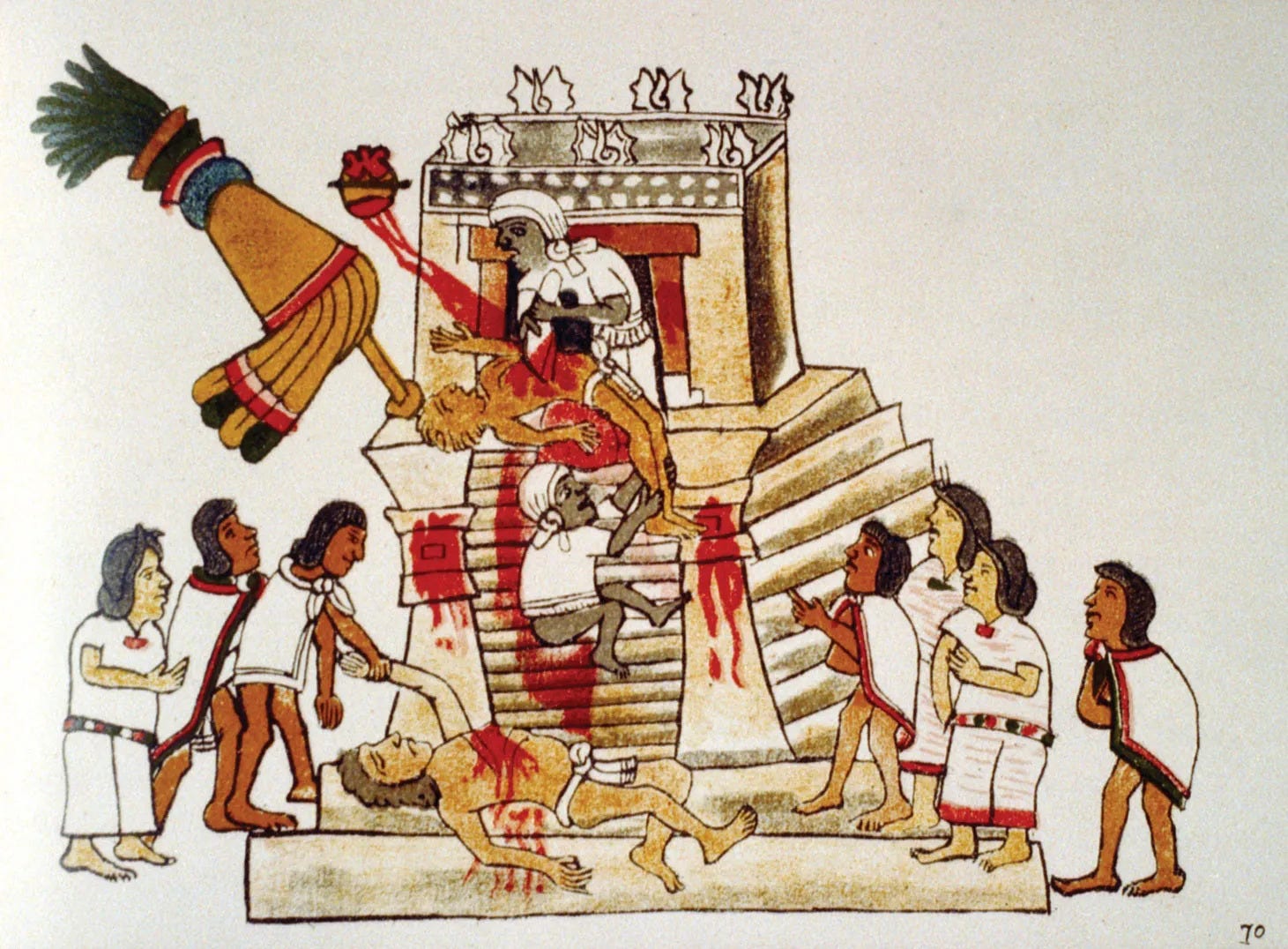
In 1487, about 30 years before Cortes invaded Mexico and destroyed the Aztec Empire, the Great Pyramid was dedicated in the capital city of Tenochtitlan. The ceremony was conducted over 5 days and involved the industrial-scale slaughter of tens of thousands of people. The Aztec records claimed the figure of 80,400; contemporary historians reduce it to between 10,000 and 30,000. But there is no debate as to how it was done:
“A line of prisoners and slaves had been assembled…They were organized into a line that stretched… a considerable distance from the base of the pyramid. One by one, they walked up the steps of the temple. One by one, they came before the priests at the top. One by one, their hearts were removed and offered to Huitzilopochtli” (Myers 176).
The beating heart was removed; the body thrown down; and the blood poured down the sides of the pyramid, eventually covering most of the city, rotting and stinking in the sun.
The Aztecs were not mindless savages. The city of Tenochtitlan was larger than any contemporary city in Europe, built on the lake and boasting impressive architecture, broad avenues, and sophisticated civic infrastructure. The Aztecs ruled a large empire, which they had conquered not long before the slaughter of the Great Pyramid. Like Cortes who put an end to this empire, the Aztecs were newcomers to the region we now called Mexico after them. They used to be a wandering tribe, originating in the semi-mythical island of Aztlan and led to glory by the promise of their god Huitzilopochtli who designated them as his chosen people.
So why did they do it? Why the unfathomable scale of human sacrifice, accompanied by ritual cannibalism? The common answer is: it was their culture. And because the Aztecs happened to be non-Europeans, any criticism of this culture in certain circles is perceived as verboten. For a long time, the conquistadors’ stories of towers built of human skulls and cloaks made of human skin were perceived as an exaggeration or slander. When the racks of skulls called tzompantli were discovered in Mexico City in 2016, confirming the conquistadors’ testimony, anthropologists’ comments centered on the theology of the Aztec religion which regarded human sacrifice as repayment of debt to the gods, before conceding that
“The scale of the rack and tower suggests they held thousands of skulls, testimony to an industry of human sacrifice unlike any other in the world.”1
Obviously, the postcolonial crowd immediately sprang to the defense of the Aztecs with the good old-fashioned “what-about-ism”. The site called Mexicolore responded to accusations of cruelty and barbarism:
The idea of what ‘barbarism’ is really lies in the eye of the beholder. Although Spanish priests thought many Aztec practices to be base and even evil, they preached in the name of an empire (the Holy Roman Empire) that regularly tortured people for the Inquisition!
The obvious answer to that is: so what? If you justify Aztecs’ hecatombs by their theology, what, exactly, is wrong with the Inquisition which was also theologically motivated? In fact, if you take cultural relativism seriously, no cultural practice can be criticized as long as it is rooted in sincere belief. This applies to FGM, slavery, and widow-burning, to name but a few. In fact, it applies to colonialism itself. Since Cortes believed that he was saving the indigenous people’s souls from eternal damnation, why should he not be seen in the same positive, or at least neutral, light as the flaying priests wearing cloaks of human skins?
The reason why so many academics continue to evade the question of moral evil in relation to the Aztecs is the same reason why so many justify the stomach-churning violence of October 7. Both events are seen in the context of settler-colonialism, which, as Adam Kirsch points out, justifies any violence by the indigenous population against the “settlers”, no matter how long ago the initial settlement occurred (7). The irony of this approach is that it cannot be logically squared with cultural relativism, and yet both function in tandem in the academy in the context of postcolonial theory. Ideology subsumes logic and common sense, as it always does.
Of course, cultural relativism is not the only lens through which to see other cultures. Theories of objective morality claim that there is a universal moral code, and that the Great Pyramid slaughter represents a clear instance of its infringement, and therefore can safely be regarded as evil. Religious deontologists argue that the foundation of this code lies in some form of divine mandate; evolutionary psychologists relate universal morality to our evolutionary origin:
An objective basis for morality can be found in an evolutionary account of its origin and development. 2
But this view also runs into a problem when confronted with the Aztecs. Human sacrifices on this scale are clearly dysfunctional for the society that practices them. Cortes’ victory was largely due to the fact that his tiny band of adventurers was joined by the conquered Mesoamerican tribes who took their chances with the unknown white invaders rather than with their cannibal overlords. Aztecs, not Europeans, were the original settler colonialists, and the way they treated their vassals was so outrageous that the rebellion, with or without Spaniards, was inevitable. Clearly other Mesoamericans recognized that there was something wrong with Aztec culture. So, why did not Aztecs themselves?
As always, SF provides us if not with the answers, then at least with the guidelines for asking the right questions. SF constantly deals with alien societies that violate our moral intuitions, as I discussed here. But aliens are, well, alien; evolution may have equipped them with a completely different set of survival tools. But what about human cultures that challenge moral relativism? SF has some illuminating examples to offer as well.
Star Trek has its Prime Directive which is constantly being violated when the crew encounters some particularly egregious example of cultural dysfunction. But Star Trek is a popular mainstream show that has very clear guardrails around uncomfortable or ideologically dissident topics. Literary SF, on the other hand, is much bolder in going where no academic mindful of their tenure prospects has gone before.
So let us consider an Aztec-related SF novel that asks whether cultures, like individuals, can be evil. And an even more “problematic”, to use the meaningless woke parlance, aspect of this novel is that the culture in question, much like indigenous Americans themselves, are victims of colonialism.

In Stolen Faces (1977) by Michael Bishop, the colony planet of Tezcatl is ruled by Glaktik Komm, a vaguely Soviet-style federation. The new kommissar Lucian Yeardance is dispatched to preside over the Tezcatlipoca Reserve where a community of people infected with the incurable leprosy-like disease called muphormosy are locked up in the Long Quarantine. The disease, much like leprosy, causes horrifying deformities: lost digits, missing eyes, noses, faces. The muphormers live on handouts from their supervisors. Unable to fend for themselves, they are supported and ruled by Glaktik Komm. Their religion centers on the worship of babies. When a healthy baby is born to sick parents, he or she is designated as a Teo/Tea, until they begin to exhibit the signs of the disease and are thrown away, to run with children’s wild packs. There is no real family and no social bonds in the Reserve; just anger and savagery.
Lucian feels guilty about the way the muphormers are treated. But digging deeper, he eventually discovers the shocking truth. There is no disease; or rather, the disease had run its course a log time ago. The muphormers are perfectly healthy. There is no need for a quarantine.
So, where do the horrifying injuries come from? You guessed it. The community inflicts them upon itself. In an atrocious blood-letting ceremony, they cut off healthy limbs, gouge out healthy eyes, slash healthy faces. Their culture is the disease.
Why do they do it? Lucian eventually comes to believe that the mutilation ceremony in which the normal babies are turned into disfigured lepers is the only way for the muphormers to achieve transcendence through ritual self-abasement, cruelty, and cannibalism:
Everything that was cut away was saved - fingers, buttock halves, ears, toes, lips, everything… you had to believe these people were deliberately abasing themselves out of a conviction of their own despicability…Everything was terribly methodical - an abattoir whose victims came sedated and smiling to the slaughtermasters…(188)
The Aztecs sacrificed others out of the sense of their own spiritual superiority; the muphormers sacrifice themselves out of the sense of their own spiritual inferiority. The result is the same because it stems from the same perverse need for purification. The muphormers’ culture is explicitly and deliberately modeled on Aztecs; and the novel includes a long and excruciatingly accurate depiction of the human sacrifice ceremony at the Great Pyramid. The Aztecs and the muphormers worship the same bloodthirsty deity: the Flayed God, Xipe Totec.
The novel ends with the Long Quarantine lifted and the muphormers’ society “reformed” by sterilizing all of its children, even though the Glaktik Komm knows perfectly well that the disease is cultural, not biological. The ultimate choice is between the ritual violence of the sick indigenous culture and the bureaucratic violence of its colonial masters. Those Mesoamerican tribes that joined Cortes faced a similar dilemma.
If you ask postcolonial thinkers, they will tell you that colonialism is the original sin of the West, far worse than anything else any other culture has ever been guilty of. Even a superficial glance at the annals of world history shows this to be a bare-faced lie. Slavery, conquest, rape and ethnic cleansing are endemic in many indigenous cultures. So, confronted with the slaughterhouse of the Great Pyramid, the temptation is to minimize, deny, or simply label you a racist for even bringing up the indigenous city literally washed in blood. As Hussein Aboubakr Mansour recently wrote, European colonialism is purged of its historical specificity in order to become the fungible moral currency in the West’s never-ending self-flagellation.
And this is where Bishop’s slender SF novel goes beyond simply reminding us that the Aztecs and other indigenous cultures could be evil. Muphormers, after all, embrace human sacrifice and cannibalism because they have internalized others’ view of themselves as sick, unworthy, in need of expiation and purification. The more you keep telling the West that it is irredeemably corrupt, the more likely it is that it might either succumb to the leprosy of self-loathing or lash out at its detractors. The bloody mask may eventually become the face.
Works Cited
Bishop, Michael. Stolen Faces, Dell, 1977.
Kirsch, Adam. On Settler Colonialism. Norton, 2024.
Myers, Eva. The Aztec Empire. 2026.
https://www.science.org/content/article/feeding-gods-hundreds-skulls-reveal-massive-scale-human-sacrifice-aztec-capital
https://www.sciencedirect.com/science/article/abs/pii/014017509190016J
Very interesting essay, as always. As someone with a longstanding fascination with the Aztecs and Mesoamerica generally, I'd like to respond to a few points in particular:
"So why did they do it? Why the unfathomable scale of human sacrifice, accompanied by ritual cannibalism? The common answer is: it was their culture. And because the Aztecs happened to be non-Europeans, any criticism of this culture in certain circles is perceived as verboten."
I think here you confuse post-colonialist discourse with actual archaeological and anthropological approaches to Aztec society. No serious Mesoamericanist has ever doubted that the Aztecs practiced human sacrifice at large scale, though numbers were grossly exaggerated post-Conquest. But the idea that it didn't happen is post-colonial fantasy and hardly worth mention given what a fringe view it is. Human sacrifice was a longstanding part of Mesoamerican culture generally, a fact indisputable from archaeology, iconography, and both Indigenous and Spanish descriptions. I also haven't encountered any Mesoamericanist, in secondary sources of personally, who shrugged it off as, "It was their culture."
Aztec sacrifice had a theological component, yes, but a political one as well (as we discussed elsewhere, I think). Theologically, it was believed that the gods had given their blood to create humanity, so humanity owed the gods a blood debt--especially since without human blood Huitzilopochtli could not protect the universe from the depredations of the star demons (tzitizimime) who would destroy humanity after an apocalyptic earthquake, thus ending our world. This theology existed prior, but was largely codified by long-term royal advisor Tlacaelel, who turned this into a justification for Aztec conquest. "Sorry, peoples of Anahuac [Mesoamerica], but we just have to do this to keep the universe running. By the way, give us your riches so it doesn't happen to your warriors." This was projected power and imperial justification.
I also don't think it's whataboutism to mention that European cultures were as brutal, albeit in different ways, because just as there are those who would erase the reality of the Aztecs' brutality, there are also those who would marshal an older counternarrative that the Spanish were the "good guys" here since they didn't sacrifice people. But Europeans did, of course. Not just in the Inquisition, but also in the Protestant witch-hunts and let us not forget the widespread nature of public torture and execution as entertainment. This was a feature of European culture as late as the 1700s, and was often both incredibly brutal and filled with religious overtones (sin, redemption, and martyrdom narratives).
For all their violence, the Aztecs didn't really torture people (nothing like the living amputations practiced in the sci-fi novel you mentioned occurred, which was when I knew the book would probably irritate me). "But none of that's human sacrifice!" the Eurocentrists might say. That's a question of perspective and semantics. We're still talking about ritual bloodshed in the name of a deity. Frankly, I'd rather have my heart cut out than be broken on the wheel or torn apart with red-hot pincers.
"The reason why so many academics continue to evade the question of moral evil in relation to the Aztecs is the same reason why so many justify the stomach-churning violence of October 7."
I get where you're coming from with this, since there is the school of thought that we are not to critique the struggles of the colonized. There's a technical term for this mindset: bullshit. But let's not fall into the trap of these ideologues. Modern-day Gaza and 16th century Tenochtitlan are societies separated by so many centuries and so much cultural difference that to lump them together in any sort of comparison obscures more than it illuminates. About all they have in common is that both have used political violence to achieve their ends. Which is pretty much every human society on the planet, ever.
"Aztecs, not Europeans, were the original settler colonialists, and the way they treated their vassals was so outrageous that the rebellion, with or without Spaniards, was inevitable."
The Aztecs were not settler-colonialists in that they neither settled nor colonized. The cultures and political structures of their vassals were largely left in place, since their empire was hegemonic. They expected tribute and taxes, not land or cultural conformity beyond the insistence that Huitzilopochtli be worshiped by the conquered in addition to their gods, to recognize his mythic triumph over their local deity. In a way, they functioned more like gangsters than colonialists.
As Mesoamerican historian Ross Hassig pointed out (forgive me, but I don't have the reference in front of me) the Spaniards supplied the means for rebellion. They had military capital for enemies of the Aztecs not due to their numbers, but their utility as shock troops. The old Mesoamerican tactic of punching through enemy lines is way more effective with mounted cavalry, though this was hardly decisive given that the Aztecs found ways to counteract most of the new technology the Spaniards brought. In the end, this was a Mesoamerican-on-Mesoamerican war that the Spaniards provided an advantage in. The unexpected (by all parties) appearance of smallpox and other diseases later on sealed the possibility of true Spanish dominance of the region (and even this didn't go unchallenged). Both the barbaric and idyllic views of the Aztecs obscure the fact that there was a lot of sophisticated Native politics going on here. Far from viewing the Spaniards as gods (this was a post-colonial invention/misinterpretation), Mesoamericans viewed them as a useful political tool, and the Conquest was hardly inevitable.
But you're right that they WERE arch-imperialists, and even as someone who tends to be sympathetic to the Aztecs, I've often come to the same conclusion you have: imperialism is imperialism, and the idea that this is a sin unique to Europe is ideological rather than at all historical. I will point out that the colonial structure the Spaniards built, centered on systems of land ownership that still fuck over Indigenous groups in Mexico today, wrought long-term destruction in Mesoamerica far beyond what Aztec dominance did. But if I'm a Tlaxcaltec or Purepecha or Totonac living in fear that the armies of Tenochtitlan are going to come in to levy punishment because my city wasn't able to supply its expected tribute, that's hardly going to change my fear and hatred of my oppressors.
In the end, I don't think judging the morality of a culture like the Aztecs is useful no matter which way we take it. Whether someone views them as saintly victims or rapacious savages says more about modern politics than Mesoamerican society and both views are woefully inadequate in understanding how they thought and why. My long term fascination with the Aztecs springs from their stark combination of indisputable genius in science, art, philosophy, engineering, and social planning with incredible violence. They're an arresting example of human duality, but--like any culture from sufficient distance in time--not one I think is constructive to judge on a moral level.
Interesting analysis. Another work of science fiction that addresses the same issues is Sheri S Tepper’s Arbai (AKA Mary Wedtriding) Trilogy especially the third book, Sideshow, in which she discusses that not all civilisations or cultures deserve our respect.