
Evolution in the Present Tense
Biopunk and the End of Humanism

There are too many “punks” in SF: cyberpunk, solarpunk, hopepunk, etc. They are the spinoffs of the original portmanteau term “cyberpunk” created by the SF writer Bruce Bethke in 1980 and popularized by the legendary editor Gardner Dozois. Cyberpunk metastasized into a minor industry with the publication of William Gibson’s Neuromancer in 1984 . However, this essay is not about cyberpunk, though I have written about it elsewhere. It is about its unjustly unrecognized younger sibling: biopunk.
So, what is biopunk? The standard definition you find online is that it is a subgenre of SF involved with biological enhancement or modification of humanity. It is analogous to cyberpunk but while the latter focuses on digital technology and AI, biopunk deals with DNA manipulation or other forms of biotechnology. Instead of mechanical or digital prosthetics found in cyberpunk (the prototype being Molly’s implanted mirrorshades in Neuromancer), biopunk offers genetic engineering, DNA resequencing, cloning or other similar technologies to create a posthuman world. The rise of DYI “biohacking” is often heralded as the dawn of a biopunk reality:
Biopunk, “with connection to do-it-yourself (DIY) biology and an open-source research in the life sciences, had already been introduced into general discourse in the form of journalism dealing with technoscientific progress…”1
But the hopes and fears of all SF punks have come up short. Anybody remembers Singularity Is Near: When Humans Transcend Biology, a 2005 book by Ray Kurzweil, promising instant transcendence into immortality and godhead through AIs? AIs are here, but godhead seems elusive, and as far as I know, Kurzweil now relies on vitamin supplements rather that uploading his mind on the cloud for extending his lifespan.
Similarly, biohacking has so far failed to deliver immortality, superpowers, or even cool body modifications. The scandals of COVID have soured people on RNA and DNA-tampering, and the excesses of trans ideology have sent them running back to the good old-fashioned biological essentialism.
But the dream of transcending humanity has not died. Instead, it has turned into a nightmare. Not the nightmare of “mad science” as conservatives believe; not of corporate malfeasance, as progressives insist; but of the real nature of humanity.
I offer a different definition of biopunk: not one focused on biotechnology but rather on biology. Biopunk, in my reading, is the SF genre of evolutionary fluidity, showing humanity not as the pinnacle of creation or the measure of all things but rather as a cosmic accident, prone to endless mutations.
Biopunk shows that we are a random and contingent fluctuation in the ocean of evolution, an accident that may never be repeated; and that our flesh, just like our minds, is a plaything of the same indifferent biological forces that have lifted us out of animality and may deposit us back in the mire any time. Or we may seize these forces and indeed turn ourselves into gods - or monsters.
Aimless Torture in Creation
Let us start a hundred years before Neuromancer and even before Watson and Crick’s 1953 discovery of DNA. In 1895 H. G. Wells wrote The Time Machine, and SF has never been the same.
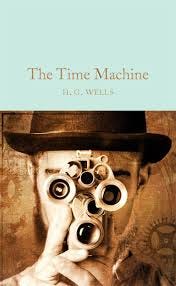
If you have only seen the cringeworthy movies based on this masterpiece, you may be forgiven to think it is an adventure romance, in which ethereal Eloi in floating white togas are being hunted down by the evil subterranean Morlocks. If you are a bit more savvy, you may believe the novel is a satire of the Victorian class division into the Haves and the Have-Nots. Neither is true.
The Eloi and the Morlocks are not allegorical representations of capitalists and workers. They are not victims and victimizers, exploiters and exploiters, good and evil. They are animals. And as animals, they are beyond all such categories into which we divide our own kind.
H. G. Wells was a trained biologist and a strict Darwinian. Taught by “Darwin’s bulldog”, T. H. Huxley whose bleak essay “Evolution and Ethics” was a major influence on The Time Machine. Wells later described the novel as the refutation of I “the placid assumption of that time [fin-de-siecle] that Evolution was a pro-human force making things better and better for mankind”. The Time Machine was written as an expression of his own alternative “vision of the aimless torture in creation” (1933, 242-243).
Neither Eloi nor the Morlocks are self-aware or truly intelligent. As devolved evolutionary descendants of Homo sapiens, they are locked into a mutually dependent cycle of predation.
“These Eloi were mere fatted cattle, which the ant-like Morlocks preserved and preyed upon – probably saw to the breeding of” (311).
But this is not cannibalism. Not only are the two kinds different species, but their relationship is dictated by the iron law of biological survival rather than by the moral calculus of good and evil. The Morlocks have to feed on the Eloi because there is nothing else for them to eat; the Eloi have to be herded by the Morlocks because they will starve on their own. The two key metaphors used to describe the two species are cattle and ants. The Eloi, the Morlocks’ cattle, have lost all that makes us human: intelligence, civilization, choice. They are no more than domesticated animals whose human-like appearance only underscores their biological degradation. “Very pleasant was their day, as pleasant as the day of the cattle in the field. Like the cattle, they knew of no enemies and provided against no needs. And their end was the same.” (321). As for the Morlocks, who have retained some of our species’ mechanical dexterity, they are ugly subterranean creatures surviving in the ruins of technological civilization like mindless ants in the anthill.
But evolution never stops; and the degradation of the Eloi and the Morlocks is not the end. The Time Traveler journeys on ahead into the future where the rotation of the Earth gradually stops and the sun goes out. He encounters more and more devolved descendants of humanity, who spread across the empty planet to fill the biological niches left untenanted by the extinction of other animals. In the episode cut out of the book version of the novel as too gruesome but included in the magazine publication, he shoots a small gray kangaroo-like animal, which still has five-digit hands and a rounded forehead. His conclusion is that “there is no reason why a degenerate humanity should not come at last to differentiate into as many species as the descendants of the mud fish who fathered all the land vertebrates” (326). Besides the kangaroo-like creature, he meets a huge white butterfly crying out in a desolate voice; giant slow-moving crablike monsters; and the ultimate horror, “a round thing, the size of a football perhaps, or, it may be, bigger, and tentacles trailed down from it; it seemed black against the weltering blood-red water, and it was hopping fitfully about” (326). All of these are our descendants, as the Traveler makes clear that in the year 802,701 AD there are no animals left - besides humans. Biopunk here is the story of humanity’s gradual and inexorable descent into animality.
Man After Man After Man….
Following Wells. the great British SF writer Olaf Stapledon created in his future history Last and First Men (1930), a cosmic panorama of 15 different evolutionary species descendent from humanity and unfolding over tens of millions of years. Some of these species are highly intelligent; some are brutish. Some reach the height of civilization; some slide back into barbarism. All go extinct. Stapledon, like Wells, questions the pieties of humanism that was becoming the dominant ethical and philosophical framework after Christianity. If man is the measure of all things, as humanists insist, what is man? Where is the dividing line between humans and animals? Evolution, as Huxley argued, is amoral. So if you discard God, where does the foundation of ethics come from? Consider that once upon a time, there were dozens of coexisting hominin species. Which one of them was truly human? If Homo erectus survived until today, would we be inclined to grant them human rights?
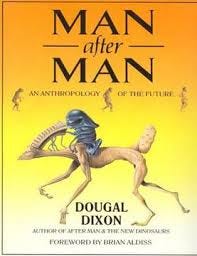
After Stapledon and Wells, biopunk evolved in two intertwined directions: evolutionary extrapolation and biotechnology. The most interesting descendant of The Time Machine is the online genre of speculative evolution, which follows Well’s unflinching Darwinism into imagining what the biological future of humanity might be like if we simply allowed nature take its cruel course. These works are fascinated with bodily modifications and corporeal monstrosity. The Morlocks, gray nocturnal creatures, variously compared to monkeys, lemurs, and swarming ants, and even Eloi, with their diseased beauty, are the prototypes of the endless YouTube videos depicting human-animal hybrids or animal-like human descendants. The early works of speculative evolution were the lavishly illustrated book by Dougal Dixon, Man After Man (1990). But now online communities and AI tools offer almost unlimited freedom to create your own posthuman descendants.
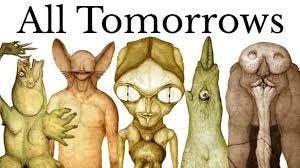
Probably the most famous of these evolutionary domains is All Tomorrows (2006), the illustrated timeline of human devolution into a myriad bizarre and highly imaginative shapes on different planets created by the Turkish artist and scholar C.M. Kosemen. 2
The initial impetus is artificial: human beings are genetically engineered by the alien race Qu but the subsequent development is natural. The Qu depart and humans keep devolving (or evolving) as their environments and history dictate. Some posthuman lineages die out because of a cosmic accident; some develop highly sophisticated cultures; some are destroyed by ecological imbalance or disease. All outcomes are equally likely; all are morally neutral; none comes as a punishment or a reward for ethical behavior.
I love speculative evolution not just because I am fascinated with monsters but also, and more importantly, because it tells us the truth that is obscured by the platitudes of humanism. We are a cosmic accident. Our ethics is irrelevant to nature. At most, it may be grounded in the specific - and random - circumstances of our evolutionary history. Once these circumstances change - as happens in The Time Machine - cannibalism, infanticide and mutual predation may become not just acceptable but inevitable.
Posthumanism is not, as some would have you believe, a sinister plot by techies to upload your mind onto the cloud. It is philosophical recognition that biology matters; that evolution never stops; and that history is more important than ideology. Posthumanism is the acknowledgment that humanism has failed to deliver utopia. In fact, it is the acknowledgment that utopia is impossible because human nature is not fixed. Our needs and desires; our very essence are in constant flux.
Becoming Gaia
Let us move on to contemporary SF. I asked one of my FB groups to offer examples of biopunk, and their response was overwhelming. In order not to overload this essay, I will post a list compiled from their suggestions separately. But I want to discuss one of the novels mentioned by several people, both because it is relatively new and because it provides an interesting contrast to The Time Machine. Adrian Tchaikovsky’s Alien Clay (2024) is an optimistic take on biopunk. I do not believe that this optimism is warranted, and I want to show you why (spoilers alert! If you want to read the novel, stop right here).
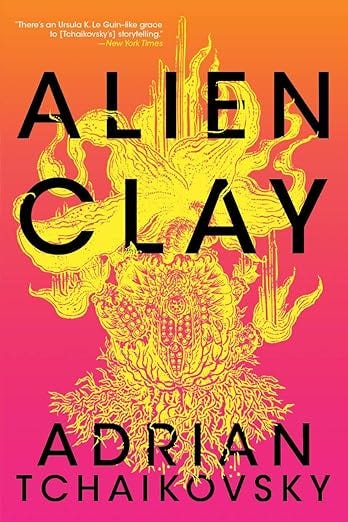
The action takes place on a concentration-camp planet where our smart-aleck first person narrator Arton Daghdev is imprisoned for resisting the authoritarian government. The novel explicitly invokes both the French Revolution and the gulag, though strangely, it never quite explains what the political ideology of the evil government called Mandate is. This is par of the course for contemporary SF, in which “oligarchy” is a meaningless label for anything oppressive (let me just remind you that actual oligarchies never had concentration camps). However, one philosophical position of Mandate is clear: it is deeply humanist, believing that humanity is the pinnacle of evolution and rejecting the very idea of “randomness” (95). According to them, “the universe is a pyramid”, with humanity on top (104).
The planet named Kiln has an unusual ecosystem based on the principle of modularity. Genetic traits can be transplanted between different organisms and different species, and even body parts can migrate freely, New organisms are “Frankensteined together by Kilnish evolution, out of parts already in our records” (95). The ecosystem is cooperative, symbiotic, and non-hierarchical.
I think we can all see where it is going. Exposed to this, cooperative biosphere, the narrator and his friends are incorporated into it, becoming part of this alien Gaia. An equal, diverse and all-inclusive community of former humans, giant worms, and moving plants is created in place of the atrocious hierarchy of the prison camp. Biology is the ultimate DEI: “I understand what it is to be part of something body and soul. And I understand what must be done to preserve this thing” (295). What must be done is, of course, a revolution that would create a utopia of mutual collaboration and interdependency:
Kiln “makes Earth look like a boxing match. How do you become the fittest on Kiln? It’s not about how many enemy empires you can trample to dust with your sandaled feet. Surviving on Kiln is all about how much life you can interlock with” (309).
After the pessimism of Lyotard and Foucault, posthumanism was co-opted by feminism and critical theory to create a new utopian ideology. Epitomized by such books as Katherine Hayles How We Became Posthuman (1999) and Rosi Braidotti’s The Posthuman (2013), progressive posthumanism (which must be the most ridiculous oxymoron in the history of ideologies) promotes a world without hierarchies, without national and even species barriers, without strife and violence - except, of course, against those who stand in the way of this glorious vision, as we have seen in the discussion of the Child in the Basement. As Braidotti describes it, a posthumanist utopia will be based on the rejection of the centralized individualistic subject and “an enlarged sense of inter-connection between self and others, including the non-human or ‘earth’ others” and on contribution to “the well-being of an enlarged community, based on environmental inter-connections” (Braidotti 48).
The posthumanist utopia is different from the hierarchical humanism of Mandate. But it is just as deadly. In his last musings, Arton knows that what he is bringing to Earth is “the second greatest monstrosity ever perpetrated upon the human species” (358). But he cannot resist. Humanism is dead. Is posthumanism any better?
So, here is biopunk, locked between the two poles of posthumanism as animality and posthumanism as transcendence. Neither offers a respite from the cruel calculus of evolution and the irresistible flow of history. But maybe embracing this flow and acknowledging both the dangers and the potential of biology is the only liberation worth having.
Works Cited
Braidotti, R. The Posthuman. London: Polity Press, 2013.
The Scientific Romances of H. G. Wells with an Introduction by the Author. London: V. Gollancz, 1933.
Adrian Tchaikovsky, Alien Clay. Hachette, 2024.
SCHMEINK, LARS. “Dystopia, Science Fiction, Posthumanism, and Liquid Modernity.” Biopunk Dystopias: Genetic Engineering, Society and Science Fiction, Liverpool University Press, 2016, pp. 18–70. JSTOR, http://www.jstor.org/stable/j.ctt1ps33cv.5. Accessed 21 June 2026.
I find this speculation interesting, even though I'm coming from a different place ethically and metaphysically. Possibly I can compartmentalise. But I enjoyed The Time Machine and Last and First Men. I probably have the late nineteenth century "Victorian pessimism" outlook that The Time Traveller displays; at any rate, I think a lot about London (where I've lived almost all my life) as a future ruin, broken-down and covered in vegetation.
Methinks we might be better off if we stick to that good old time religion.