
The End of Humanism
A Guide for the Perplexed, Part 1

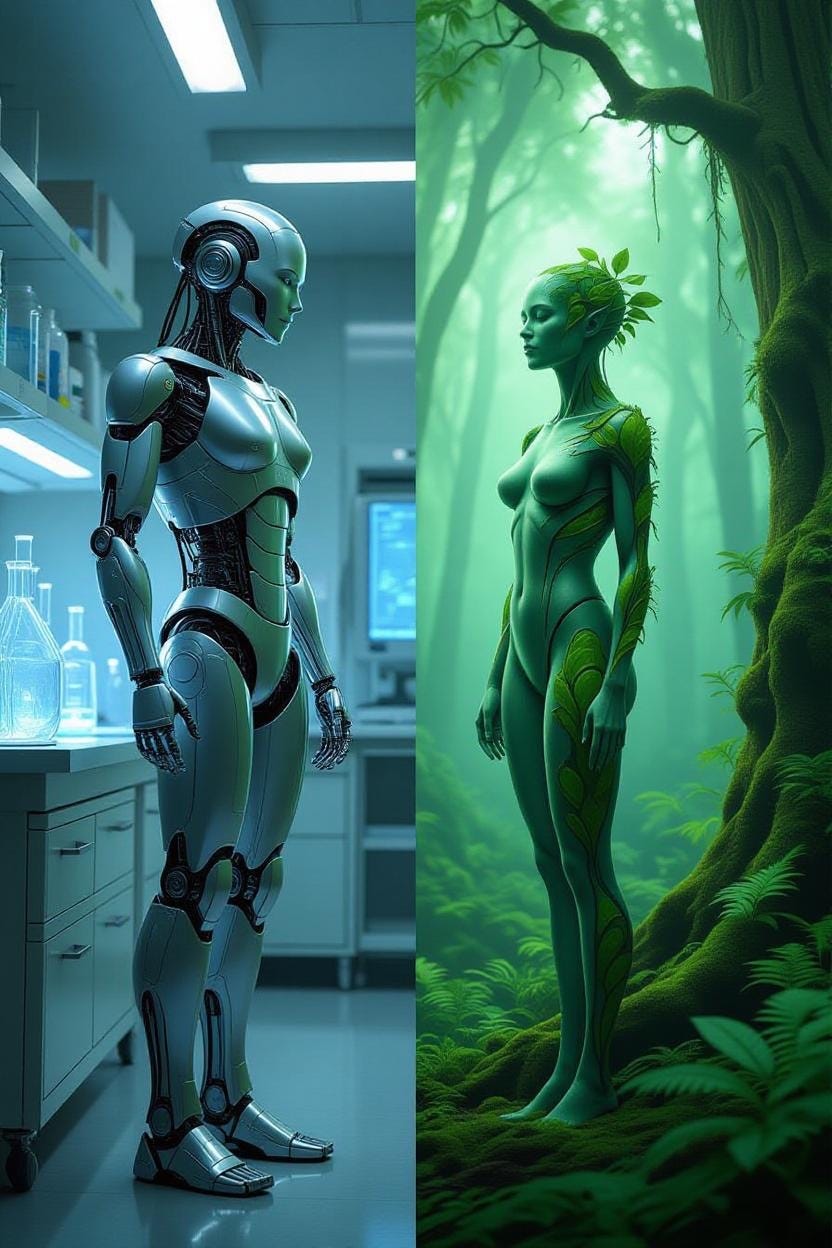
This is a new experimental format. Since the issues discussed are so complex, I decided to split my essay into two parts. Part 1 here defines the three key terms: anti-humanism, posthumanism, and transhumanism. Part 2 (coming soon) will talk about SF novels that illustrate each term.
Recently a new scandal broke in the media world: Bari Weiss is reputedly selling The Free Press to Larry Ellison. I do not know whether it’s true, and I don’t care. In a capitalist society, a successful publication, such as The Free Press is allowed to sell itself to the highest bidder. What I do find interesting is this reaction from Break Free Media . Discussing Ellison, Karen Hunt aka KH Mezek wrote:
“Support for Israel is vital, but nothing will ever take precedence over the transhumanist agenda…Transhumanism is rooted in fascism/Nazism. Transhumanism—or really posthumanism, is all about eugenics and creating the “master race.” We mere humans are lab rats in a gigantic petri dish, to be experimented on so that a few lucky ones can replace God and become Gods.”
What does transhumanism have to do with media takeovers? Well, it has become an article of faith on both the left and the right that a sinister cabal of Silicon Valley billionaires are pushing the eugenicist/transhumanist/posthumanist agenda. As in the quote above, the three terms are often used interchangeably. For anybody interested in ideas, however, this appears perplexing. If transhumanism and posthumanism are the same, why do we need two words? And how does eugenics connect to new cellphones?
As always in this publication, I am going to untangle this semantic and conceptual confusion through the lens of speculative fiction. I have already written about the origin of eugenics here, so let us put this aside and go back to posthumanism and transhumanism. The two are not the same. In fact, they are opposites. And while you may not like Larry Ellison, Israel, Bari Weiss, billionaires, or all of the above, both posthumanism and transhumanism deserve serious consideration. The reason is that both offer an alternative to the collapse of humanism as an ideology, philosophy, and ethics.
The death of Man
Roland Barthes writes in Mythologies (1957): “Any classic humanism…assumes that in scratching the history of men a little…one very quickly reaches the solid rock of universal human nature”1
And then he proceeds to demolish this assumption with his usual wit and eloquence. For Barthes, there is no universal human nature at all. Everything is contingent, relative, and fluid. “Nature itself is historical”, and therefore, no form of ethics is universal.
Later, Michel Foucault gave his usual provocative re-statement of Barthes’ critique of humanism. Foucault writes in The Order of Things (1974):
“It is comforting, however, and a source of profound relief to think that man is only a recent invention, a figure not yet two centuries old, a new wrinkle in our knowledge, and that he will disappear again as soon as that knowledge has discovered a new form” (xviii).
What does that mean? Certainly Foucault did not believe that Homo sapiens sapiens appeared out of nowhere two centuries ago. However, his point was that we are not autonomous biological creatures. We are vehicles for ideologies, narratives, forms of knowledge and powers (for Foucault, the two are synonyms). Like Lyotard, another prominent postmodernist, Foucault denied the existence of universal human nature, universal ethical values, and universal human rights. For him, humanism was irrevocably compromised by historical contingency and by the fact that individuals are immersed in, and constructed by, language. As Lyotard described it, “human beings, in humanism’s sense of the word, [are] in the process of, constrained into, becoming inhuman” (2).
Barthes, Lyotard and Foucault were anti-humanists in the Nietzschean tradition (see my essay on Nietzsche’s Ubermensch here). They neither believed in universal human nature nor embraced the ethics of humanism. Knowledge is not power, as the Enlightenment claimed; instead, power is knowledge. They criticized the universalist aspirations of humanism in the name of what Nietzsche called “the transvaluation of values”. In other words, no sacred cow was to be left uninspected and un-slaughtered, and this included the notions that all men are created equal; that humans have universal rights; and that a just society can exist. Foucault believed in power, not in DEI. He welcomed the Iranian Revolution not because he had any sympathy with Islam but because he delighted in a naked surge of change, even if it is a change for the worse.
Not a nice person, you would say, and you might be right. But at least an honest one. And remember that without criticism, any system of beliefs eventually calcifies into repressive heterodoxy. And this includes humanism, which is as much a system of beliefs as Christianity or Islam.
However, something peculiar happened to the anti-humanist philosophical tradition as it evolved into a political movement. While Foucault’s positions are closer to the contemporary alt-right, he is seen as a patron saint of the radical left. Critical Theory certainly counts him (and Barthes) among its forefathers. But how? Why?
Probably the most common (and overused) term on the left today is “dehumanizing”. The left has embraced a particularly whiny version of humanism, in which a simple disagreement or a contrary opinion is seen as an attempt at “dehumanizing” the opponent. A representative example is the clash over a conservative speaker at Stanford Law School (2023) in which a legal discussion was shouted down by violent protesters because it somehow diminished “the humanity of the students”.2 What can you say about the worldview which sees humanity as an impossibly fragile accolade, easily shattered by a reference to the Supreme Court’s decisions?
The “woke” left has embraced the cognitive relativism of postmodernists but coupled it with a puritanical morality, turning humanism into an illiberal ideology used for censorship and cancellation. The one great virtue of Foucault and other postmodernists was intellectual consistency. Critical Theory plugs the gaping holes in its discourse with the supposed ethics of “empathy” and “inclusion”, creating an unholy mishmash of censoriousness and doublespeak. Anti-humanism has become posthumanism.
Animals and other victims
Posthumanism is essentially an attempt to preserve the insights of anti-humanism but make them into the foundation for a new ethics. Perhaps the most significant contribution to this philosophy is Rosie Braidotti’s The Posthuman (2013). The book opens with a critique of anthropocentrism, which is
the classical ideal of ‘Man’…a set of mental, discursive and spiritual values. Together they uphold a specific view of what is ‘human’ about humanity. Moreover, they assert with unshakeable certainty the almost boundless capacity for humans to pursue their individual and collective perfectibility (Braidotti 12).
But she is not willing to give up on the idea of universal morality. Now this morality is extended to all living beings, elevating the same Nature that Barthes so casually dismissed to the position of a secular deity. Braidotti tries to create a more “inclusive” form of ethics that encompasses animals, the environment, and ultimately everything that exists in a supposedly non-hierarchical community. Needless to say, this position is both philosophically and politically incoherent, but it is increasingly powerful in various forms of eco-criticism and DEI. The paradox of the philosophy of inclusion becoming the ideology of exclusion is perfectly demonstrated in the Stanford episode mentioned above. A conservative judge is dehumanized by those who preach extending humanism to animals and rocks.
But what would a posthuman future actually be like? The obvious answer is that it would be a future with no humans. Since no human society has ever been non-hierarchical, a “just” existence means getting rid of humanity altogether. This desire is quite obvious in the philosophy of the Anthropocene, which is the name given to the geological period in which human activity impacts the climate. Timothy Morton writes in his influential book Hyperobjects: Philosophy and Ecology After the End of the World :
“The ground of being is shaken…The end of the world has already occurred (37; 18).
Of course, it is easy to point out that the end of the world has not occurred, and is not scheduled to occur any time soon. While global warming is a serious danger, Earth has gone through at least five major extinction events caused by rapid climate shifts. Extinctions are not unnatural catastrophes but the engines of evolution. Humanity will adapt, technologically and culturally, as it adapted to other climate events in the past. But the posthumanism is not about science. It is about utopia.
Philosophical posthumanism is underpinned by a deep-seated desire to end humanity as it exists today and to go back to some imaginary Rousseau-like paradise of nature. The runaway bestseller The World Without Us by Alan Weisman (2007) practically revels in images of abandoned cities and ruined technology. The book is a perfect expression of what Freud would call the death-wish on a collective scale.
Posthumanism is philosophically incoherent and politically dangerous. So, can we dispense with all this DEI talk and go back to the insights of anti-humanism which promises the unity of power/knowledge? Yes, we can. Enter the Silicon Valley.
Waiting for the Singularity
The founder of the transhumanist movement is not a philosopher but a tech entrepreneur. Ray Kurzweil published The Singularity is Near: When Human Transcend Biology in 2005. A sequel The Singularity is Nearer was published last year, which begs the question what the next instalment is going to be called.
The Singularity is the supposed moment of transcendence in which the advent of AIs will lift humanity up into the realm of the Ubermensch. In the original book, Kurzweil does not quite explain how this will occur. And since AIs are now a part of daily life and no observable increase in average intelligence is happening (if anything, the reverse is the case), we might be tempted to relegate the Singularity to what Marxists used to call “the junk-heap of history”. But in fact, transhumanism is by now a global movement, having rebranded itself as HumanityPlus. And as opposed to Kurzweil’s original reliance on AIs, the current incarnation of transhumanism sets its sight on biology. The Silicon Valley is teeming with biotech start-up. many of them fly-by-night nonsense, but some quite promising. A conference in 2026 called "Frontline Intelligence Forum” in Washington, DC will “discuss and debate initiatives, policies, and strategies for Longevity and AI”.
Why would anybody object to longevity? Well, apart from the fact that Elon Musk, universally hated by the left, is a transhumanist, the apparent fear is that biotechnologies will usher in a world of even greater inequality and “injustice”. But there is no logical reason why this should be so. In fact, every new biomedical advance eventually spreads downward, permeating the entire society. Antibiotics, contraceptives, and IVF are available to just about everybody in the developed world. And even if the Silicon Valley elites manage to make themselves near-immortal ahead of everybody else or to produce preternaturally smart children, so what? They already have enormous power. Through algorithms, they control language. They are the embodiment of Foucault’s power/knowledge. If you don’t like it, who do you think should be the social elite? Ideologues? We tried it in the last century. Theocrats? We are trying it right now in Iran. Elected politicians? Dissatisfaction with democracy is roiling the West because majoritarian decisions do not fall in line with ideological passions.
No, the real reason why transhumanism is hated is because it has internalized the lessons of philosophical anti-humanism much better than self-contradictory posthumanism. There is no human nature. There is no divine power. Morality is a human creation and it can be un-created or made anew. Marx talked about the leap from the “kingdom of necessity” to the “kingdom of freedom”. We have made this leap, and it is too late to go back now.
In Part 2, I am going to discuss three SF novels, each illustrating one philosophical trend: Arthur C. Clarke, Childhood’s End; Tim Lebbon’s Eden; and Greg Egan’s story “Chaff”.
Works Cited
Braidotti, Rosie. The Posthuman (Polity Press, 2013)
Foucault, Michel. The Order of Things: An Archeology of Human Knowledge (Random House, 1974).
Lyotard, Jean-Francois. The Inhuman (Stanford University Press, 1991)
Morton, Timothy. Hyperobjects: Philosophy and Ecology after the End of the World. (University of Minnesota Press, 2013).
https://www.uky.edu/~tmute2/nature-society/password-protect/nature-society-pdfs/barthes-mythos-famofman.pdf
Greg Lukianoff and Rikki Schlott, The Canceling of the American Mind (Simon and Schuster 2023, 136).
There is a lot to absorb here. For my part, I’m not ready to accept Barthes, anti-humanism. I do think a lot of this is driven by technology, and some of the names we give to these things or ways of rationalizing, but we have no control over. A lot of people, myself included, turned to religion with the downfall of humanism. But I’m kind of hoping for a romantic resurgenceor a romantic, religious hybrid. That’s the optimistic part of me the pessimistic part sees the brave New World coming, whether we like it or not.
Well, I appreciate your attempt to address all this. On to other things.