
Space Colonialism
Who Is a Native in an Alien World?

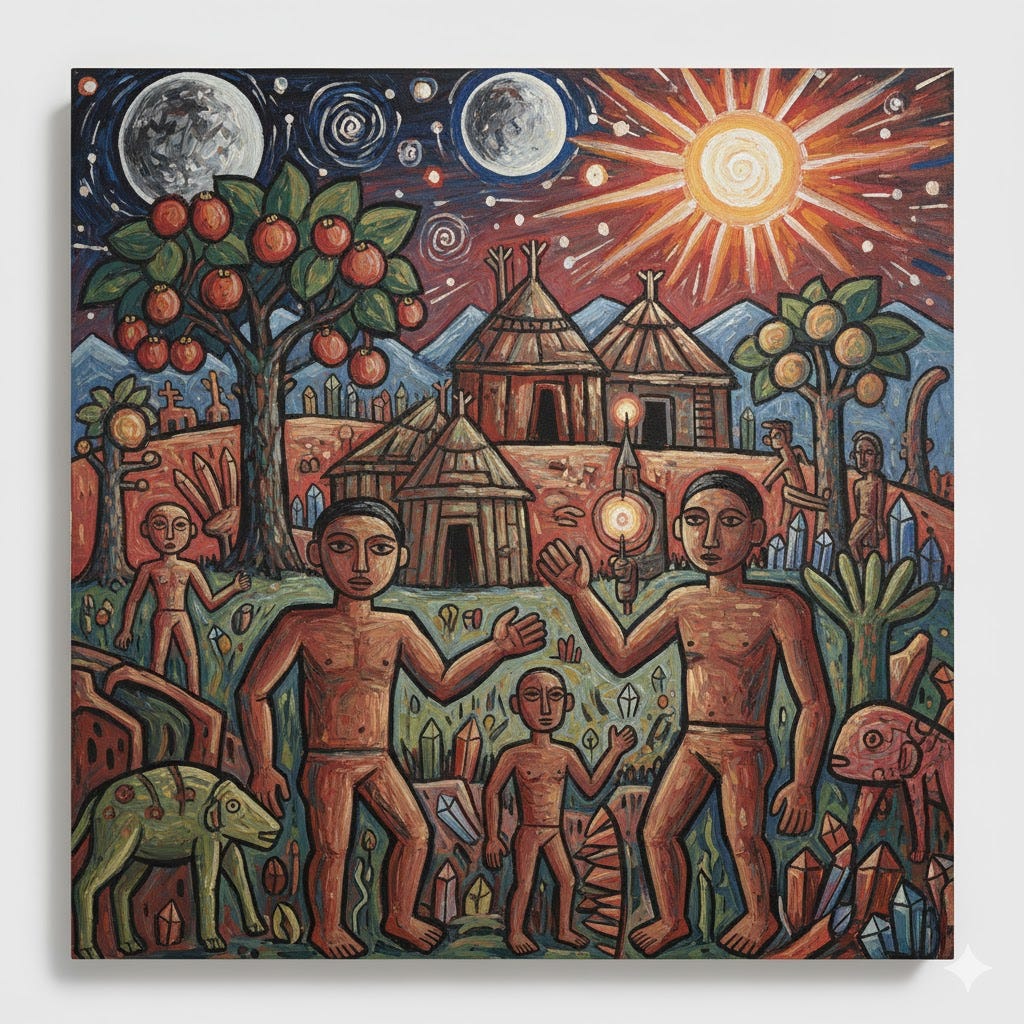
The Original Sin
The recent kerfuffle about “stolen lands” provides a perfect opportunity to see what SF has to say on the subject. After all, no other genre is as involved with the ideas of colonization and settlement as the SF of space exploration.
The concept of settler colonialism was introduced by Patrick Wolfe and Lorenzo Veracini within the context of postcolonial studies, previously developed by Franz Fanon, Edward Said and others. In my other Stack, I will provide a more thorough discussion of this concept and offer a critique. For our purposes here, it will suffice to define Settler Colonial Theory (SCT) as the branch of the humanities dealing with the historical “logic” of new populations moving into, and taking over, other lands.
Colonization and resettlement are a major part of human history. The Roman Empire colonized half the known world and imposed their culture and legal system on the subjugated tribes (which, to be honest, was a huge improvement in most cases). The Aztecs conquered, massacred, and sacrificed their neighbors. Istanbul was once Constantinople. The Ottoman Empire forcibly converted Christians on its territory. The Arab armies conquered and settled the Middle East. The USSR moved the Crimean Tatars to Siberia and settled Russians in Ukraine and the Baltics. I can go on, but anybody with access to Google can find enough examples to fill an entire volume. However, what is called SCT today does not deal with the similarities and differences among all the myriad ways in which populations were displaced or moved around the globe. Instead, as Adam Kirsch writes in his excellent book on the subject,
The concept is so fertile because it offers a political theory of the original sin. Settler colonialism means that violence involved in a nation’s founding continues to define every aspect of its life, even after centuries - its economic arrangements, environmental practices, gender relations (8).
In other words, the settlers can never become the natives. Even centuries later, Americans and Australians of European descent are interlopers who are marked by the stain of what their remote ancestors had done. The only way to atone for this original sin is through “decolonization”. And what does “decolonization” mean? The jubilant response of the portions of the left to the atrocities of October 7 makes it clear that it means violence. Only through the genocide of the settlers will a new world be born, or rather, the imaginary old world will be restored. Settlers have no future on the “stolen land”, regardless of how many generations have passed. As several professors quoted in Kirsch’s book write, “‘relinquishing settler futurity’ is necessary if we are to imagine ‘the Native futures, the lives to be lived once the settler nation is gone’” (10).
The settlers can never become the natives. Something in the soil of the new place will reject the alien blood. Blut und Boden, the Nazi concept of Blood and Soil, reborn in a new guise!
But while this ideological poison is seeping from the academy into public discourse, SF is still busy trying to imagine settler futurities - depicting humans colonizing new planets, both empty and inhabited. I am not going to discuss the scientific plausibility of, say, a colony on Mars, let alone the possibility of reaching other solar systems. I regard SF as a mirror of culture, which influences society by reflecting and magnifying our collective dreams and nightmares. Elon Musk in his latest talk at Davos seemed to be regurgitating all the familiar SF cliches, from humanoid robots (Asimov) to a Martian colony (Bradbury). Who knows, he may still be able to make pulps into reality!
Colonizing other planets is a very common trope in SF, so later I will post a Recommended Reading list of what I consider the best novels on the subject. But here I want to discuss only two novels: one describing the colonization of an uninhabited planet; and one where the “genocide” of the natives has taken place. The question I want to consider is the same Adam Kirsch asks in his book in relation to the US, Australia, or South Africa. Can a settler become a native?
Space Madness
John Brunner (1934-1995) was a prolific British SF writer, probably best known for his overpopulation dystopia Stand on Zanzibar. But his short novel Bedlam Planet (1968) is more interesting. It is about a new colony on the planet of Asgard where the colonists are forced by circumstances to switch to a native-grown diet despite their reservations about doing so. What ensues is an epidemic of hallucinations, apparent mental illness, and strange behavior among the first people to live off the land. The test group escapes the colony and sabotages their spaceship, so the Earth people now have to make Asgard their home.
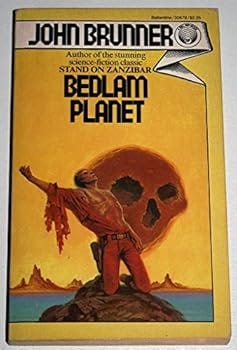
Some postcolonial theorists who bother to read SF will confidently tell you that everything written before Afrofuturism is a swamp of white supremacy, if not Nazism. Of course, it is not true. The colonists in Brunner’s novel are a multinational and multiethnic bunch. They include an Irishman, an Indian, a Chinese, an African, and so on. Women play leadership roles, and the small colony is a democracy. Ethnic diversity is actually very important in the plot, but not in a way you expect.
What happens to the group who feed off the native plants is that they step back into mythological and archetypal roles of their cultures of origin. Denis Malone, the protagonist, acts out the Celtic legends of Finn and Cu Chulainn. The colony’s psychologist Parvati finds herself immersed in the archetype of Kali, the Divine Mother. Tai Men dreams of the August Personage of Jade and the immortal Hare. The African Daniel Sakky relives the story of climb to the Moon and the shamanistic journey in which “truth about life; truth about death” shall be revealed (107). And so on; every person eating native food plunges back into the archetypal waters of the collective unconscious where the foundational myths of all human cultures mingle and coexist.
Carl Gustav Jung’s theory of the collective unconscious was very influential in the 1960s. It is based on the observation that mythological narratives across different cultures have similar features. From that, Jung developed an elaborate scheme of common archetypes that shape our behavior. Best understood as a poetic metaphor, in my view, Jung’s theory emphasizes what settler-colonialism ideology ignores. We are all human. Natives or settlers, Aboriginals or Europeans, we share the same deep psychological structures shaped in the unremembered past of our Paleolithic and Neolithic ancestors who freely moved across the globe, colonizing whatever land they chanced upon (and often killing off its other hominin inhabitants). The collective unconscious recognizes no distinctions of skin color, race, or ethnicity.
In Brunner’s novel, it turns out that this dip in the ocean of archetypes is what the colonists needed to put down roots in their new home. After they wake up from their mythical delirium, they are no longer what they once were. They have become new people; the people of Asgard. As Dennis realizes, those who refuse native food are still clinging to their old identities, while he regards Asgard as home:
“He seemed to be looking at the potential of Asgard, a whole new planet; they, at the ways in which Asgard fell short of the Earthly ideal” (145).
At the end, the first “new Asgardians” become archetypes in their own right, an epic myth for the subsequent generations of the colonists. The settlers are the natives now.
Who Are the Martians?
But Asgard has no intelligent natives. What happens when Earth people colonize an already populated planet?
SF represents a whole range of options here. You have weepy allegories of postcolonial guilt, such as Ursula Le Guin’s The Word for World is Forest (1972). You have realistic narratives of natives’ exploitation and revolt, such as Michael Mammay’s recent Planetside (2018), which, refreshingly, does not apologize for its military protagonist who kills alines because he has to defend humans. You have stories in which natives and settlers blend together into a new culture, such as Gene Wolfe’s The Fifth Head of Cerberus (1972) and Robert Silverberg’s Lord Valentine’s Castle (1980) and its sequels (this, to me, is the most interesting kind and I am planning to write more about it later). You even have novels in which the settlers and the natives live side by side but without any meaningful interaction, such as Paul McAuley’s Of the Fall (1989).
But I want to end this essay with the novel everybody knows about but few seem to understand: Ray Bradbury’s The Martian Chronicles (1950). Composed of separate stories written in Bradbury’s signature lyrical style, this novel depicts the colonization of Mars after its native inhabitants (who killed the first two expeditions) died of smallpox brought by the Earthmen.
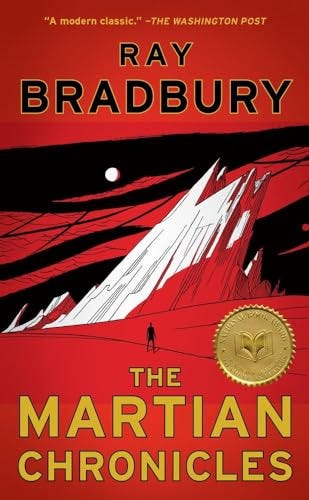
The novel is clearly an allegory of American history. It includes a parody of the 1950s suburban paradise and a meditation on Edgar Allan Poe; a denunciation of racism, with black Americans abandoning Earth en masse, and memories of the Dust Bowl; Wild West style settlements and a dream of the lost past on a newly-laid Martian highway. But most of all, it is a story of how the settlers become the natives.
The native Martians are not the Noble Savages of the postcolonial Rosseau-inflected delusion. Nor are they evil or malevolent. They are both different and similar; both strange and familiar. They have jealous husbands and stupid psychologists; but they also have gossamer cities and wine-filled canals. They are telepathic and possess psychic abilities. But most of all, they are gone.
They are killed by disease, as were a vast majority of the inhabitants of the Americas after the Europeans came. If you listen to postcolonial ideologues, it was an intentional genocide. A more rational view would regard it as an accident of history, contingent on the fact that Native Americans had no immunity to zoonoses. Does it absolve the original Europeans of guilt? What absolves them is the fact that they are all dead, and guilt does not pass infinitely down the generations.
In The Martian Chronicles, the dead Martians become a legend, a myth, a spooky story, a vision of the past. They become the “black leaves” of their desiccated bodies that children play with; and the longing for the lost splendor that makes a lonely driver on a Martian highway imagine their cities still standing. But ultimately, they blend with the minds of those who are now the real Martians: the Earth settlers.
At the end of the novel, as Earth is consumed by a nuclear catastrophe, a settler family on Mars drives to the canal where the father promises his children to show them Martians:
“I’ve always wanted to see a Martian,” said Michael/ “Where are they, Dad? You promised.”
“There they are,” said Dad, and he shifted Michael on his shoulder and pointed straight down.
The Martians were there. Timothy began to shiver.
The Martians were there - in the canal - reflected in the water. Timothy and Micharl and Robert and Mom and Dad.
The Martians stared back up at them for a long. long silent time from the rippling water…” (181).
It is not blood and soil but history and imagination that make a settler into a native.
Works Cited
Bradbury, Ray. The Martian Chronicles. Bantam, 1958.
Brunner, John. Bedlam Planet. Del Rey Books, 1968
Kirsch, Adam. On Settler Colonialism: Ideology, Violence, and Justice. W.W. Norton, 2024.
That was amazing to read. I am going to buy Bedlam Planet.
“Ours is a world substantially shaped by the opaque operation of abstract systems.”
is a sharp observation and provocative