
The Utopian Basement
Revisiting Ursula Le Guin's "The Ones Who Walk Away from Omelas"

A recent op-ed in SFGate, the Silicon Valley newspaper, starts with a reference to an SF story. This in itself is not surprising: the Valley is crawling with SF fans, including most tech bros. What is surprising is the story chosen:
Recently, my partner told me about a 1973 short story by Ursula K. Le Guin called “The Ones Who Walk Away from Omelas.” It’s about a utopian city where hedonistic residents live in peace, abundance and harmony among its rollicking meadows and hillsides. But these same euphoric citizens harbor a shameful secret that they refuse to acknowledge: In order to maintain their bountiful harvest, their family’s health, and the beauty of their town, they must torture a bruised, helpless child trapped inside in a room. Once exposed to this known secret, some people decide to leave Omelas — but many don’t.
You might reasonably ask why the writer did not bother reading the story herself instead of receiving a summary from her partner but this is a minor point. The op-ed is an impassionate diatribe against the supposed “class war” waged by billionaires on the rest of us. It is a list of aggrieved complaints about tech and especially AI for killing white-collar jobs and eventually, as the new robotics developments demonstrate, manual labor as well.
They don’t care that data centers are depleting precious natural resources and creating heat islands. They don’t care that fake job postings are demoralizing unemployed workers. And they certainly don’t care about the thousands of recently laid-off employees who can’t feed their families. Why would they care about robbing retail workers of their livelihoods, especially when they’re the ones profiting off of it?
This is uncomfortably reminiscent of the complaints against factory automation penned a hundred years ago. But regardless of whether the apocalyptic predictions of mass unemployment are correct (not in my view), what does the abused child in Le Guin’s fable have to do with dancing robots?
“The Ones Who Walk Away from Omelas” was included in Le Guin’s seminal collection The Wind’s Twelve Quarters (1973). What follows is a detailed analysis of it, so spoilers alert!
The story begins with a long description of a summer celebration in the city of Omelas. With her consummate skill, Le Guin describes the pure unenforced joy of the parade. But then, she breaks the fictional “fourth wall” of her world and addresses the reader directly:
Given a description such as this one tends to look next for the King… But there was no king. They did not use swords, or keep slaves. They were not barbarians, I do not know the rules and laws of their society, but I suspect that they were singularly few. As they did without monarchy and slavery, so they also got on without the stock exchange, the advertisement, the secret police, and the bomb… 1
Let us start here. If you want to use Omelas as an allegory for the predation of tech capitalism, you may want to read it first. Omelas is not capitalistic. It is not based on slavery or wage theft. It is not based on surveillance or any other dystopian cliche.
So, what is it based on?
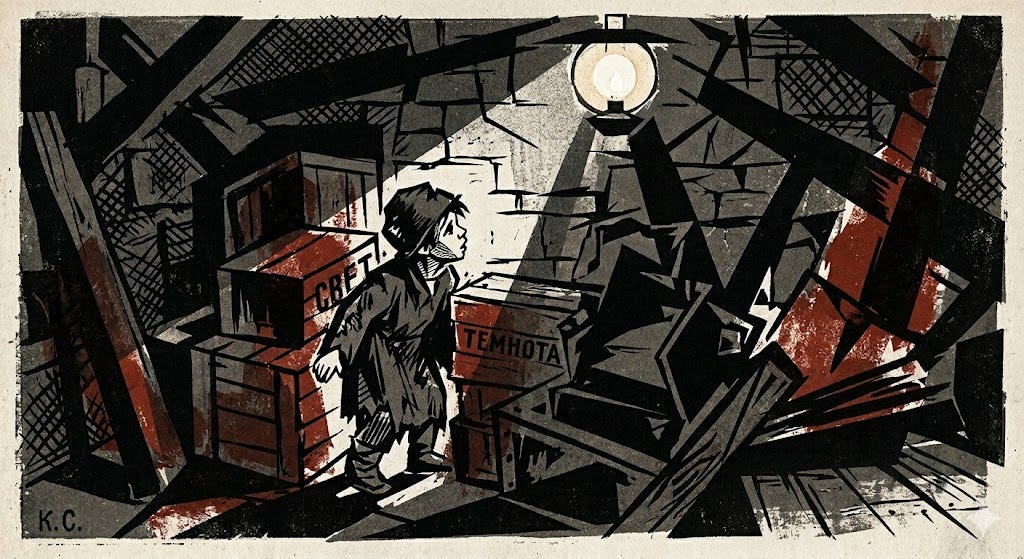
In a basement under one of the beautiful public buildings of Omelas, or perhaps in the cellar of one of its spacious private homes, there is a room. It has one locked door, and no window. A little light seeps in dustily between cracks in the boards, secondhand from a cobwebbed window somewhere across the cellar. In one corner of the little room a couple of mops, with stiff, clotted, foul-smelling heads, stand near a rusty bucket. The floor is dirt, a little damp to the touch, as cellar dirt usually is.
The room is about three paces long and two wide: a mere broom closet or disused tool room. In the room, a child is sitting. It could be a boy or a girl. It looks about six, but actually is nearly ten. It is feeble-minded. Perhaps it was born defective, or perhaps it has become imbecile through fear, malnutrition, and neglect. It picks its nose and occasionally fumbles vaguely with its toes or genitals, as it sits hunched in the corner farthest from the bucket and the two mops. It is afraid of the mops. It finds them horrible. It shuts its eyes, but it knows the mops are still standing there; and the door is locked; and nobody will come. The door is always locked; and nobody ever comes, except that sometimes--the child has no understanding of time or interval--sometimes the door rattles terribly and opens, and a person, or several people, are there. One of them may come in and kick the child to make it stand up. The others never come close, but peer in at it with frightened, disgusted eyes. The food bowl and the water jug are hastily filled, the door is locked; the eyes disappear. The people at the door never say anything, but the child, who has not always lived in the tool room, and can remember sunlight and its mother’s voice, sometimes speaks. “I will be good, “ it says. “Please let me out. I will be good!” They never answer.
It is a devastating description; and what makes it even more devastating is its truthfulness. Le Guin does not mince words and does not use the weasel vocabulary of “political correctness”. The child is an “it” because it has been dehumanized by the utopians of Omelas to such an extent that it has no name, sex, or any other identity. It is intellectually disabled because some people are. It cries for its mother because it is being tortured.
And why is it being tortured? Well, because the existence of the utopia depends on the child’s torment.
They all know that it has to be there. Some of them understand why, and some do not, but they all understand that their happiness, the beauty of their city, the tenderness of their friendships, the health of their children, the wisdom of their scholars, the skill of their makers, even the abundance of their harvest and the kindly weather of their skies, depend wholly on this child’s abominable misery.
If the child is let out of its closet, the utopia will be over. Everything described in the first section - the joy and happiness; the equality and camaraderie; the perfect harmony of Omelas - will crumble in an instant. You will trade one already damaged life for the thousands of healthy and happy ones. Is it an ethical bargain?
Some scholars point to the origin of the story in a passage from Dostoyevsky’s The Karamazov Brothers (though Le Guin herself denied it). In this passage, Dostoyevsky, a passionate Christian, asks whether the suffering of a single child is the fair price to pay for the redemption of the world. His answer is no:
I absolutely reject that higher harmony. It’s not worth one little tear from one single little tortured child, beating its breast with its little fists in its foul-smelling lock-up, and praying with its unexpiated tears to its “Dear Father God!” 2
But Omelas is not about theodicy but about social harmony and justice. The child is not being tortured in the name of otherworldly salvation but in the name of a improving this world, getting rid of injustice, exploitation, and inequality. And so it is another Dostoyevsky’s novel that is relevant here: The Possessed (1872) (the Russian title translates as The Demons). The novel is a macabre depiction of the progressives of his time: a bunch of high-minded ideologues who quickly descend into terrorism, murder, and child abuse. An unparalleled analysis of the psychology of a revolutionary, the novel offers a glimpse into the nexus of utopia and violence and suggests that this nexus is necessary and not accidental.
Dostoyevsky offers a key to the mystery at the heart of Le Guin’s story: why is the torment of the child necessary? The answer is that no utopia can exist without the dark cellars where “enemies of the people” are being tortured. The child is a symbol; a stand-in for the many victims that the relentless pursuit of social harmony is bound to create. Since utopia aims for perfection, it cannot cope with the messiness and contrariness of human nature. The more it tries to realize its vision of social justice, the more it becomes clear that some people will never be on board with it, no matter what. So, what is left? Purification through violence. If we can just get rid of (capitalists, war-mongers, intellectuals, MAGA, Jews or whoever the enemy du jour is), the rest will live in peace and harmony.
But something happens as the relentless purification of society is being pursued: the process of killing itself becomes pleasurable, uplifting, sublime. Peace and harmony may be unachievable but the exaltation of of power and violence is real. Torture of dissidents, extermination of class enemies, cruelty inflicted upon the enemy families and children are no longer the means to an end but the end itself. It is not simply that you need to break eggs to make an omelet. The omelet is not the goal; breaking eggs is. Utopia IS violence.
But in Le Guin’s story, there are some who simply walk away. Unable to bear the torture of the child but also unwilling to destroy the happiness of their fellow citizens, they walk to…where? Nobody knows. The way to understand this enigmatic ending is perhaps through the juxtaposition of utopia and what Fredric Jameson called “the utopian impulse” - the desire to do better, the restless impulse to escape the constraints of the present and reach toward the future. Those who walk away are not walking toward a specific goal, be it socialism, communism, or any other version of the millennium. They are just walking. They do not know where they end up, and this is the beauty of their gesture. This walking away is what we call progress.
So, to go back to the SFGate diatribe against tech - it is based on the misreading of the story. Setting aside the fact that losing your job is not the same as being thrown into the Gulag (reread the description of the child to know what the latter was like), the tech entrepreneurs the author mocks are not creating a utopia. They are creating something new, something different. They themselves do not know what the end result is going to be. They are the ones who reach out toward the unknown and unpredictable. They are the ones who walk away.
In 2020, N.K. Jemisin wrote her own version of Omelas called “The Ones Who Stay and Fight”. If you want to understand the warning of Le Guin, read this repulsive piece of the giddy glorification of violence in the service of utopia. It is all here: the exaltation of righteous killing; the smug satisfaction of a murderer; the unshakable belief that the end justified the means; and most of all, the blind fanaticism of a true believer:
This is the paradox of tolerance, the treason of free speech: We hesitate to admit that some people are just fucking evil and need to be stopped.
But there is only one treatment for this toxin once it gets into the blood: fighting it. Tooth and nail, spear and claw, up close and brutal; no quarter can be given, no parole, no debate.
This is the same logic that drowned the world in blood in the last century and that still animates the would-be revolutionaries who believe that after more than a 100 million dead in the service of socialism alone, another victim will finally tip the scales and we will all tumble into the bright future of postcolonial bliss.
Let us be clear: Jemisin’s utopia has been tried in the Killing Fields of Cambodia, in the Cultural Revolution, in the Gulag, and on October 7. And the result has always been the same: an abused child, crying for its mummy in the dark basement, and the ideologues telling you that it does not matter.
https://shsdavisapes.pbworks.com/f/Omelas.pdf
https://delphinius56.wordpress.com/2014/11/02/fyodor-dostoevsky-the-karamazov-brothers-suffering-of-children/
Sometime between Dostoyevsky's tale and LeGuin's, there was Shirley Jackson's "The Lottery." The similarities (particularly to LeGuin's story) are so blatant that I was surprised to see it missing from this discussion.
The parallels are glaringly obvious -- but then again, there are also some vexing (thematic) disparities.
Wait . . . The Ones Who Stay and Fight was sincere??? I thought the author intended it to be satirical, a misinterpretation upon which my appreciation for the story was entirely dependent, 🤣!
I just read it again. It's insufferably smug when not read as satire.
Do you think she knows the Weimar Republic had strict laws against hate speech and defamation, which were strictly enforced through fines and prison sentences against hundreds of Nazi agitators (including Goebbels), but attempts at censorship only increased their support by casting them as unfairly treated? There were posters of Hitler's face with his mouth taped shut to express outrage over efforts to silence his message.
(I'm open to arguments that the Internet and social media have led to a critically dysfunctional marketplace of ideas, but that doesn't mean censorship is a viable solution to the problem.)