
Chickens in Space
How NOT to write about aliens

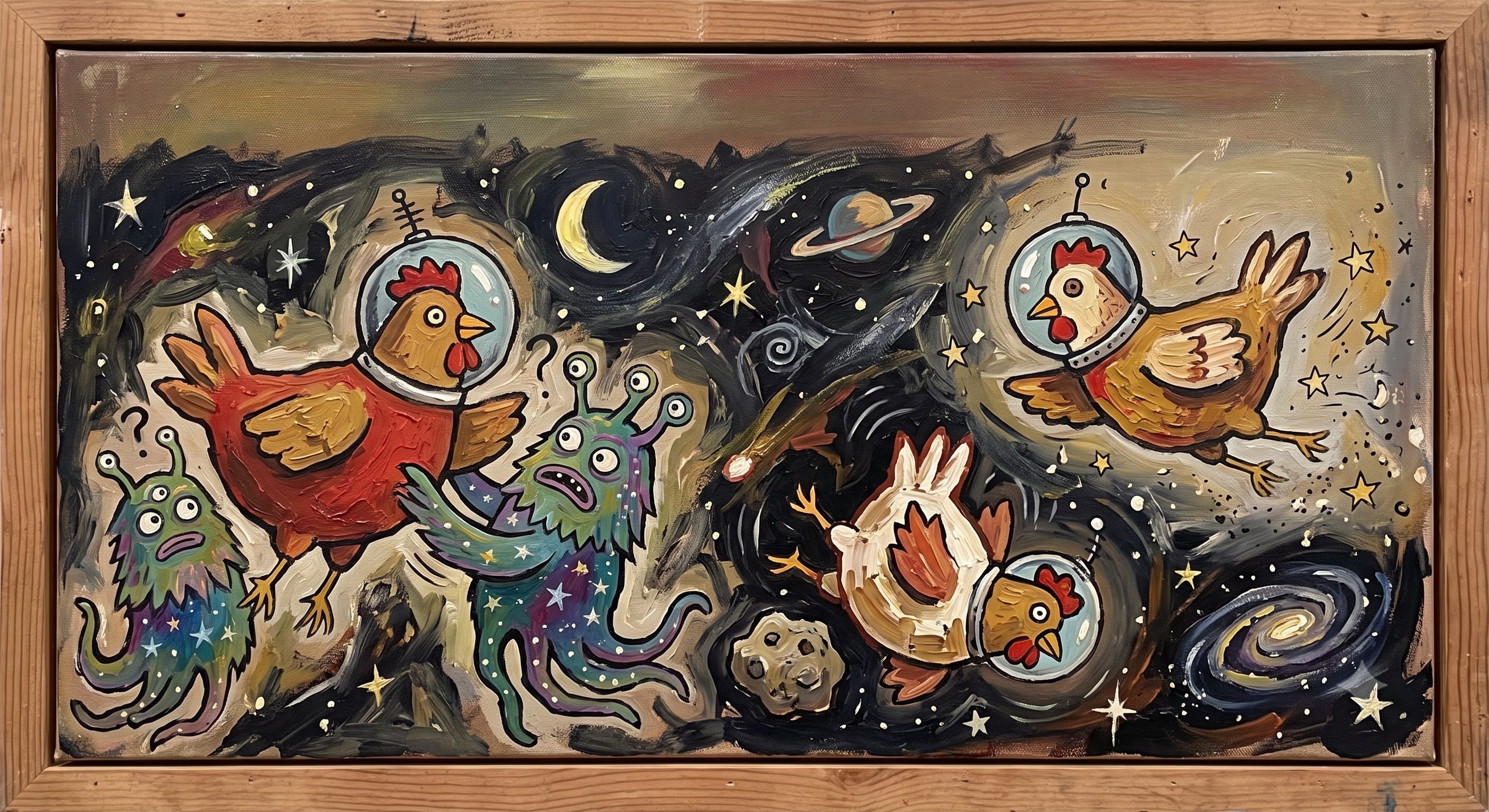
I once published a list of five best SF novels of alien encounter to be found here. This short essay is a sort of addendum to it. I wanted to post a list of five worst novels about aliens but then I realized that 1. It would be mean-spirited, and I am only mean-spirited on special occasions. 2. The list, to be comprehensive, would have to include at least 500 titles. So, instead I will just list the worst tropes of alien contact, each illustrated by one novel.
Let me just add that some of the novels I list are not necessarily bad. They may be entertaining or well-written. But they fail to deliver what SF is for: cognitive defamiliarization, or to in simpler words, they fail to make you think and to see the familiar world in a new and unfamiliar way.
Aliens are just like us, only better.
It hardly needs to be said that aliens cannot be like us. Without descending into the endless philosophical debates about the nature of consciousness and the definition of intelligence, it is clear that creatures that evolved in a very different environment would be very different from us not just physically but mentally as well. We cannot communicate even with semi-intelligent species on our planet, such as corvids and cetaceans. The notion that a cosmic squid can just drop by and start chatting about the weather is preposterous. But it also undermines the main artistic goal of SF: creating the sense of wonder and defamiliarizing the commonplace. I cannot tell you how many times I have been disappointed by picking up a novel by a writer I like and finding humans in alien costumes.
Example: Larry Niven and Jerry Pournelle Footfall (1985).
The novel is a snappy war thriller, but its aliens are disappointing. The biology of the Fithp is based on elephants; their inner world, however, is indistinguishable from ours, which is demonstrated by the extensive inner focalization through alien characters. The chapters in which tusked and trunked creatures agonize about their broken relationships or bad bosses read like an animal fable. The Fithp are about as different from us as Babar the Elephant.
2. Aliens are just like us, only worse.
Alien invasions are my guilty pleasure. You can find my two essays on this topic here and here. But why would aliens even bother to invade? What does Earth have that intelligent creatures would cross interstellar distances to exterminate or enslave an ordinary mammalian species? Some writers, such as Peter Watts in Blindsight (2006) or Arthur C. Clarke in Childhood’s End (1953), come up with mind-blowing explanations. But other simply decide that since human history is a series of invasions and empires, aliens would do the same (forgetting that Alexander the Great and the East India Company had sound political and economic reasons for what they did). Coming up with convincing alien cultures is time-consuming. So, let’s just have some bad aliens who invade because they can.
Example: Robert Heinlein, Starship Troopers (1959).
The novel has been unjustly accused of fascism. Heinlein was no fascist, and Paul Verhoeven’s movie based on it (1997) is an exquisite parody of fascist aesthetics. But the Bugs in Starship Troopers are indeed the prototype of all malevolent aliens, battling humanity simply because the plot requires it.
Aliens are gods.
To me, the most annoying character in Star Trek: Next Generation is Q: a smart aleck with unlimited divine power. Would a god really muck about with the crew of Enterprise if he could create and destroy worlds at will? Many pagan gods are, in fact, trickster or deliberately cruel and malevolent. But even Loki and Hades have an aura of the sublime clinging to them. The anthropomorphic gods of ancient mythologies are still wrapped up in mystery and awe. But as aliens supplanted angels and demons in our imagination, they have become the Hallmark vision of the divine: showing up in the halo of light and dispensing cosmic wisdom you can find in any self-help book. Without descending into the rabbit hole of UFO cults or beating the dead horse of Close Encounters of the Third Kind, we can find this deplorable reduction of godhood to pop-spirituality in many SF novels.
Example: Carl Sagan, Contact (1985)
I loved Sagan as a popularizer of science, but this novel is an embarrassment. If your mystical vision of communing with a godlike intelligence boils down to reconciliation with your Daddy, maybe consult a therapist.
Aliens are helpless childlike creatures in need of our assistance.
I am not sure why anybody would want to mother an alien child, but somehow, the idea has taken root in many otherwise good writers’ minds. I largely blame Spielberg’s ET, of course; but this is one silly trope that refuses to die. Perhaps as an antidote to hive minds, giant spiders and the rest of the evil-alien menagerie, some writers want us to treat aliens like stray cats or, in the case of my next example, cosmic chickens.
Example: Stephen Baxter, Creation Node (2023).
Baxter is a very good writer, and some of his aliens, especially in the Xeeleee series, are quite memorable. But in this standalone novel, the birdlike female alien abandoned on the mysterious Planet Nine and nicknamed Feathers, is mothered by a crew consisting exclusively of women. Feathers does nothing except singing and laying eggs, so wouldn’t it be easier to get a coop? Incidentally, while I very much appreciate women as protagonists in SF, I have to confess that having entire space crews consisting of women only is not only implausible but boring. Moreover, it tends to confirm some of the worst stereotypes of women as kind, nurturing, etc. If it were me, I would probably abandon Feathers to her own devices and go on to explore Planet Nine.
Aliens are noble savages, resisting Earth invaders
I have written about the fraught intersection of postcolonialism and SF

But let me just add that Noble Savages have never existed on Earth, so finding them in space is highly unlikely. The problem with postcolonialism is that it adopts Rousseau’s discredited philosophy in which civilization (capitalism for his modern descendants) is responsible for all the evil in the world. Postcolonial thinkers conveniently forget that indigenous cultures were every bit as bloody, cruel, warlike, unequal, and morally compromised as the West. They were not as powerful and technologically developed, however, which resulted in their conquest or cultural assimilation.
There are some thoughtful SF novels which explore what happens when humans confront an alien culture that is less developed than ours. Michael Bishop’s Transfiguration is an excellent example of anthropological SF, which presents an encounter with a deeply dysfunctional and degraded indigenous alien culture. But when SF turns into an allegory of postcolonial guilt, it becomes propaganda.
Example: Ursula Le Guin, The Word for World is Forest (1972)
Written at the height of the opposition to the war in Vietnam, this novel is disappointing in two ways. Read as straightforward SF, it suffers from the same issue as Footfall - humanizing the aliens in ways that make them not alien at all. Read as a political allegory, it distorts what the Vietnam war was all about. The Viet Kong were not noble savages, living in harmony with nature, but a modern ideological and political movement that proceeded to jail and massacre its opponents immediately after gaining victory in the war. No political insight is gained from dressing them up as cuddly green aliens.
I think two things here. One, an enormous amount of the SF in which aliens play an important role is allegorical in nature. You mention this in connection with Le Guin, but that's also true of Starship Troopers, which Heinlein made no bones about being an allegory of the Korean War.
Another example would be Mike Resnick's Galactic Comedy trilogy, which he makes clear is about Africa: specifically Kenya, Rhodesia and Uganda.
So it seems to me a bit unfair to criticize authors who make aliens that think and act like humans when that's the explicit, up-front intent.
Another issue is that--while it's true that aliens will be the product of their own development in their own environment--a civilization that is the dominant species on their world--as we are here on Earth--will necessarily share certain characteristics that are the hallmarks of such species: specifically, they will be aggressive and territorial.
An alien race of cows or sheep is never going to become the civilization that dominates their world, let alone have the impetus to become a spacefaring species.
Nowadays aliens in SF are problematic for me for 2 reasons, (1) because I can't suspend enough disbelief to accept actual aliens having enough congruence with human mental process/perspective to communicate productively with us, and (2) authors overdose on high-concept BS to make the aliens seem mysterious, magical, whatever. I'd much rather read something like Vance's Planet of Adventure series, where the aliens are embodiments of a single human tendency taken to the extreme: The Wankh are bureaucrats, the Dirdir ultra-prideful hunters, the Chasch nomadic foraging warriors, and the Pnume obsessive cultists. That was great genre writing that didn't pretend to be more than it was.